Disinformation research is advancing around the world. Yet it is still surprisingly difficult to discover who is working on which problems, where complementary expertise exists and how to initiate collaboration across institutional and national boundaries.
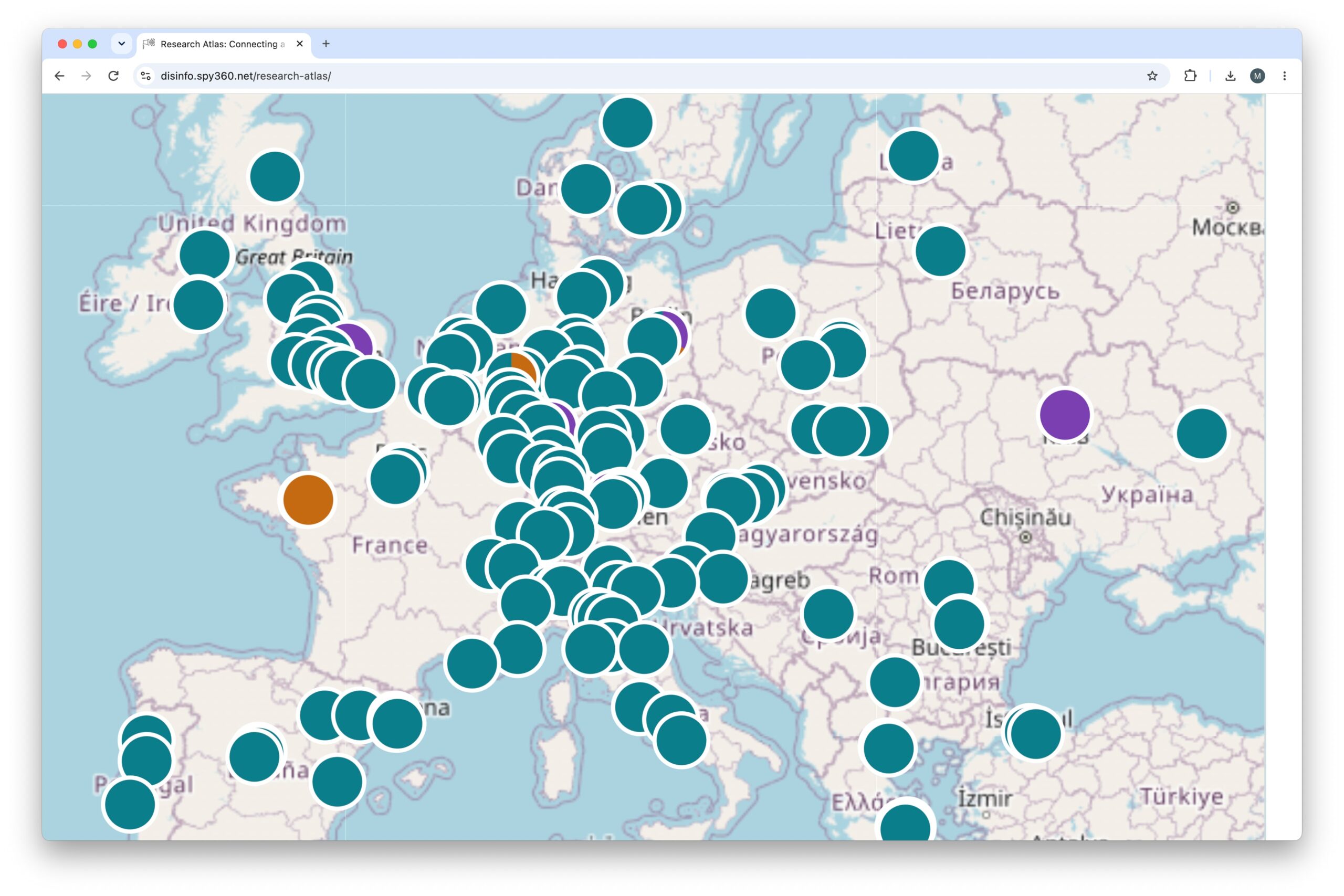
Today we are introducing the Disinformation Research Atlas: a living, searchable directory and interactive map designed to connect the global community working on disinformation, AI-enabled influence operations and information integrity.
A research community needs more than a list of publications
Important work is distributed across computer science, cybersecurity, journalism, linguistics, psychology, education, governance, social sciences and operational organisations. These disciplines often study different parts of the same challenge, yet may not know about one another’s projects, datasets, tools or research interests.
The Atlas is intended to make this landscape more visible. It helps researchers discover related activities, identify complementary capabilities and find people with whom to exchange methods, evidence and ideas. The ambition is not to rank researchers or institutions, but to facilitate collaboration.
What can you do in the Research Atlas?
- Discover researchers and initiatives: browse a searchable directory and interactive geographical map.
- Present your research project: share its topic, location, participating organisations, relevant outputs and research context.
- Join as an individual: researchers can list their interests and expertise even without an active project.
- Find complementary expertise: use the growing overview to identify potential scientific partners and exchange opportunities.
- Keep information current: request a fresh email verification code to update an existing entry.
Contributing is straightforward
Visit the Research Atlas and use the submission form at the bottom of the page. Enter your email address to receive a six-character verification code, then add your information. The same mechanism lets you return later to update your entry. You can choose whether your contact email is publicly displayed.
Both established initiatives and emerging projects are welcome, as are independent researchers and people whose work spans several disciplines. The more varied the contributions, the more useful the Atlas becomes.
From the Dresden workshop to an international resource
The Atlas grows out of the international workshop From Prompt to Propaganda: Generative AI and the New Disinformation Lifecycle, held in Dresden on 22 September 2026. The workshop connected scientific research with fact-checking, cybersecurity, governance and national perspectives, making the complementarity — and fragmentation — of existing capabilities particularly visible.
The open-access workshop report provides an initial ecosystem cartography, eight cross-cutting findings and thirteen emerging research challenges. The Atlas turns one part of that vision into an ongoing community resource that can grow far beyond the workshop and Europe.
An invitation to the worldwide community
A directory only becomes valuable when researchers contribute and keep their information up to date. We therefore invite you to add your own work, share the Atlas with colleagues and suggest missing research initiatives. Entries are contributed by participants; inclusion does not imply endorsement or a formal partnership.
Our goal is to make the global disinformation research community easier to discover, easier to connect and better equipped to collaborate.
Leave a Reply