
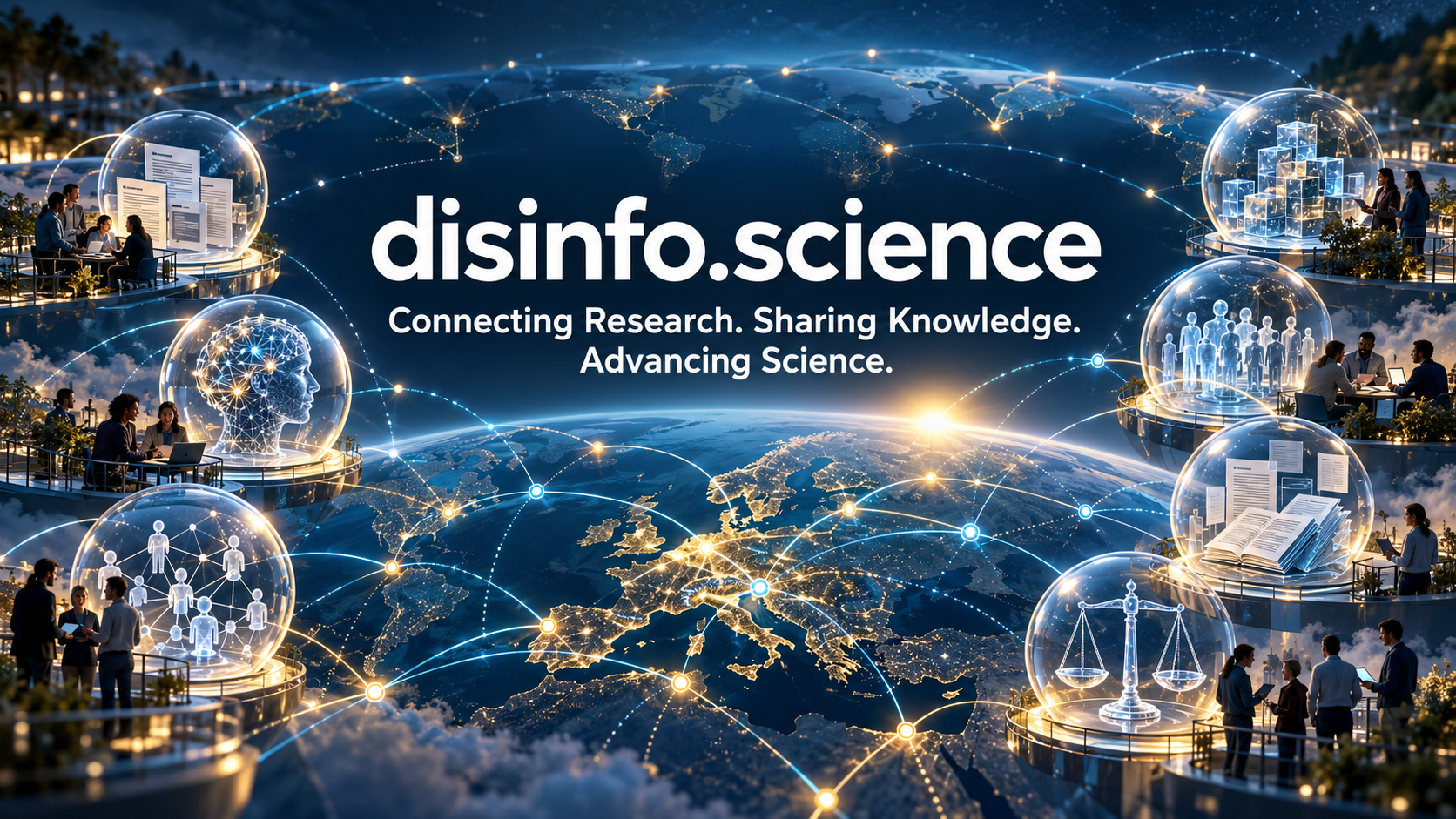
A shorter address. A bigger ambition. A shared space for connecting scientific expertise against disinformation.
Our initiative has a new home: disinfo.science. What began at disinfo.spy360.net now has a more memorable address, reflecting our ambition to build a lasting, valuable resource for the international disinformation research community. The previous address remains accessible, so existing links continue to work.
But this is about more than a domain name. Disinformation crosses scientific disciplines, institutions and national borders. The research needed to understand and counter it must connect across those boundaries too.
Disinformation is a societal challenge — and a scientific one
Disinformation can distort public debate, undermine confidence in institutions, exploit social divisions and misrepresent scientific evidence. Generative AI introduces new possibilities for producing convincing manipulative content at scale, but the underlying challenges are not exclusively technological.
Understanding them requires contributions from computer science, cybersecurity, psychology, communication studies, political science, sociology, law, economics and many other fields. Researchers study provenance and detection, cognitive vulnerabilities and persuasion, information diffusion, regulatory responses, media ecosystems and public discourse.
The challenge is not simply to produce more research. It is to connect what we already know, identify what we do not yet understand and make interdisciplinary collaboration easier.
Building on an important European ecosystem
We are not starting from zero. Europe already has important initiatives working on disinformation and information integrity. EU DisinfoLab brings together researchers, civil society, practitioners and policymakers through investigations, knowledge-sharing and policy activities. The European Digital Media Observatory (EDMO) connects academic researchers, fact-checkers and media-literacy specialists across Europe. EUvsDisinfo, an initiative of the European External Action Service, documents and analyses foreign information manipulation, particularly pro-Kremlin disinformation. European research projects such as vera.ai demonstrate how collaborative research can advance verification technologies.
These efforts demonstrate the strength and diversity of the existing ecosystem. Our ambition is not to replace them, but to complement them by making scientific expertise more discoverable and opportunities for joint research easier to identify.
From individual projects to a connected research landscape
Research often develops within specialised disciplines, institutional networks and time-limited projects. This focus is valuable, but it can make complementary expertise difficult to discover. A psychologist studying susceptibility to manipulation may benefit from computational modelling; a cybersecurity researcher studying coordinated influence operations may need political communication expertise; a legal scholar studying platform accountability may need a deeper understanding of technical limitations.
That is why we are developing the European Disinformation Research Atlas: a living resource to make projects, institutions, individual researchers and their expertise easier to find. It is not intended as an institutional ranking or closed membership directory. Its purpose is to support discovery, complementarity and collaboration, including across communities that do not routinely work together.
From a workshop to a lasting scientific resource
Our interdisciplinary Disinformation Space workshop in Dresden provided an important starting point. Its discussions brought different perspectives together and helped identify eight findings and thirteen research challenges. We want that exchange to continue beyond a single event.
- A living research atlas connecting projects, institutions and individual researchers.
- An interdisciplinary research agenda highlighting open questions and opportunities for joint investigation.
- Accessible scientific contributions including workshop presentations, recordings and research findings.
- Community exchange that encourages connections and future collaboration.
These resources are intended to evolve through contributions from the community.
Why disinfo.science?
The choice is deliberate. Disinfo makes the subject immediately recognisable. .science expresses a commitment to scientific inquiry, interdisciplinary exchange, methodological rigour and evidence-based understanding.
Scientific research does not provide a simple answer to every question. It does, however, offer methods to distinguish established evidence from uncertainty, test assumptions and critically evaluate proposed solutions. Those principles are essential to developing effective and responsible responses to disinformation.
An invitation to contribute
A valuable research community cannot be built by one institution, project or discipline alone. We invite researchers, research groups, institutions and interdisciplinary initiatives to contribute to the evolving atlas, share their expertise, discover complementary work and help shape future research questions.
Journalists, policymakers, educators, practitioners and interested citizens are equally welcome to explore the research landscape and the people working to understand this important societal challenge.
Disinformation crosses borders and disciplines. Our research collaborations should do the same.
Welcome to disinfo.science.
Connecting research. Sharing knowledge. Advancing the science of disinformation.
Leave a Reply